
Seven hills, a lagoon, pink flamingos flying over the city in formation, and at the summit, Castello, a Pisan fortress watching over the Mediterranean. Cagliari is not merely an administrative capital; it is a Mediterranean metropolis in the fullest sense, where the Italian art of living meets nature preserved with rare intensity. For international buyers, the city represents a singular equation: the comfort of a real city, the authenticity of an island, the climate of a seaside resort. A guided tour.
In Summary
Cagliari combines urban life, beaches, a university and an international airport—a rarity in the Mediterranean that few capitals offer. The most sought-after neighborhoods are Castello, Marina, Villanova and Bonaria, with price ranges of €3,500 to €6,500/m² for the luxury segment. Poetto beach, stretching 8 km and bordered by the lagoon with pink flamingos, makes Cagliari one of the rare major cities in the world where you can swim in the morning and dine in the city center in the evening.
The Neighborhoods to Move to
Cagliari is composed of a mosaic of highly differentiated neighborhoods. For those seeking an exceptional property, four stand out.
Castello – the Historic Heart
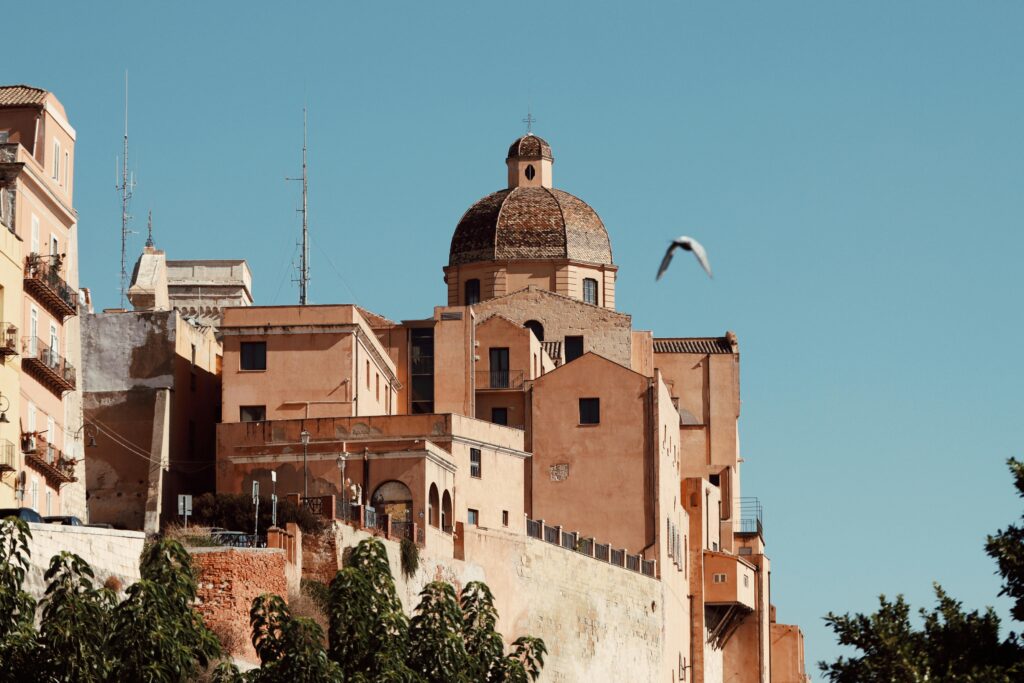
The elevated neighborhood, perched on the eponymous hill. Noble palaces, paved alleyways, panoramic views over the gulf. Here you find character apartments in buildings from the 15th to 19th centuries, often with suspended terraces. The Bastion Saint-Remy, emblem of the city, anchors the neighborhood’s identity. This is the most prestigious segment of the Cagliari market and one of the most constrained, as the perimeter is listed.
Marina – Harbor Bustle
Below Castello, the Marina neighborhood is the old quarter of sailors. Restored over the past two decades, it now offers a mix of historic buildings and trendy cafés. Via Roma borders the port and concentrates hotels and brasseries. Buyers seek bright apartments here with views of the boats; the ratio of view/charm/urban life is particularly attractive.
Villanova and Bonaria – Elegant Residential
Quieter, more tree-lined, these two neighborhoods attract buyers seeking intimacy with services nearby. The Giardino Sotto le Mura and the sanctuary of Nostra Signora di Bonaria give these neighborhoods their character. Beautiful Art Deco and mid-century villas with gardens, in a range of €4,000 to €6,000/m² for the luxury segment.
Poetto and Quartu Sant’Elena – The Seaside
For those who prioritize seaside living without sacrificing urban proximity, Poetto and the neighboring municipality of Quartu Sant’Elena offer beachfront apartments and villas. Expect €3,000 to €5,000/m² depending on location. The city center is a 15-minute drive away.
The Beach in the City and Beyond
This is probably the most striking singularity of Cagliari: Poetto beach, which stretches 8 kilometers of white sand from Sella del Diavolo to Quartu Sant’Elena, is within the city. About ten minutes by car from the center, accessible by bus, equipped with beach bars, beach restaurants and water sports clubs.
Just behind it, the Molentargius lagoon, now a regional natural park, permanently hosts several thousand pink flamingos. You can walk there, cycle, or observe them from the city’s terraces. The superposition of these two ecosystems, urban and lagoon, is unique in the Mediterranean.
For wilder coves, you need to drive 20 to 40 minutes: Mari Pintau with its round pebbles and turquoise water, Calamosca nestled behind Sella del Diavolo, or the wider beaches to the south towards Pula and Chia.
A Gastronomic Scene Worthy of a Capital
Sardinian cuisine holds its own in Cagliari, between peasant traditions and contemporary refinement. Fregola con arselle (pearl semolina with clams), culurgiones (ravioli filled with potato, mint and pecorino), bottarga di muggine (mullet roe, a local specialty grated over pasta), or porceddu (spit-roasted suckling pig) form the foundation.
Among the tables, Dal Corsaro, Michelin-starred for several years, offers Sardinian cuisine reinvented by chef Stefano Deidda in an elegant setting. Luigi Pomata, a local figure for tuna prepared in countless ways, runs an institution on Via Sassari. For popular cuisine, historic trattorias in Marina like Lillicu, a fish house since 1938, perpetuate an almost unchanged tradition.
The covered market of San Benedetto, one of the largest in the Mediterranean, deserves a morning visit: fishmongers, butchers, cheese makers, greengrocers… an opportunity to grasp the richness of an island that produces almost everything it consumes.
Practical Life: What Changes with Capital Status
Cagliari is the only major city in Sardinia that doesn’t empty out in winter. All services are available year-round: university hospitals of reference, university (one of the oldest in Italy, founded in 1606), lyric theatre, opera, major museums, and a well-stocked commercial fabric that includes international brands.
The international Mario Mameli airport (Cagliari-Elmas) is 8 km from the center, fifteen minutes by car, with a direct train every twenty minutes. Daily connections to Paris, London, Geneva, Zurich, Madrid, Frankfurt. This is one of the structural advantages of the capital compared to more remote destinations: you can be in Paris in less than three hours door-to-door.
As for schools: International School of Sardinia (IB program from primary to secondary), a French lycée and several private international schools. The supply is more limited than in Milan or Rome, but it exists. This is a major differentiating point for international families.
Culture and Lifestyle: A City That Lives
Cagliari hosts in May the Sagra di Sant’Efisio, one of the most important religious and folkloric processions in Italy: three days of traditional costume parades, horsemen, polyphonic chanting. It’s an opportunity to measure the depth of Sardinian identity.
The Teatro Lirico offers a recognized season of opera and classical music. Contemporary art galleries, headed by the Galleria Comunale d’Arte, animate a vibrant artistic scene.
On a daily basis, the city offers a singular rhythm of life: you lunch facing the sea at noon, return to the alleyways of Castello for aperitifs, dine late under the arcades of Marina. The climate, more than 300 days of sunshine per year, allows almost permanent outdoor living.
Cagliari’s Real Estate Market in 2026
| Neighborhood | Price Range per m² | Property Profile |
|---|---|---|
| Castello | €4,500 — €6,500 | Character apartments |
| Marina | €3,800 — €5,500 | Port view apartments |
| Villanova / Bonaria | €4,000 — €6,000 | Bourgeois villas and apartments |
| Poetto / Quartu | €3,000 — €5,000 | Beachfront, seaside |
| San Benedetto / Genneruxi | €3,500 — €5,000 | Quiet residential family area |
These ranges correspond to the luxury segment. Average prices across the entire market hover around €2,700/m², with moderate but steady progression over the past three years (+1.9% on average in 2025). The market remains more accessible than northern Italian capitals (Milan or Bologna, which exceed €4,500/m² on average) and offers, at equivalent budget, significantly larger properties.
OGGI Support in Cagliari
Cagliari is OGGI’s natural terrain: the agency has its historic office there, Via Manno, just a few steps from the Bastion Saint-Remy. Murielle and Gérard personally know the notaries, surveyors and architects of the center, and work with a network of local artisans who have been working on listed heritage properties for decades.
The high-end Cagliari market is largely off-market; many palaces are transmitted by word of mouth, without public announcement. This is precisely where the value of a real estate agent becomes apparent: accessing what is not advertised.
In Summary
Cagliari is probably the most singular city in the western Mediterranean: capital of an island, urban beach, wild lagoon in the heart of the city, three millennia of heritage, exceptional climate, services year-round. It offers international buyers a rare compromise between urban life and seaside quality of life without the seasonal aspect that characterizes purely tourist destinations.
For those seeking a primary residence or a high-end pied-à-terre in Sardinia, it is very often the starting point and sometimes the endpoint.
Frequently Asked Questions About Cagliari
Is Cagliari accessible year-round from France?
Yes. Cagliari-Elmas airport is served year-round by several airlines (Air France, easyJet, Ryanair, Volotea…) from Paris, Lyon, Marseille, Nice. Expect approximately 2h20 of direct flight from Paris. Frequency is slightly increased from April to October, but daily flights exist even in the depths of winter, which is not the case for Olbia.
Which are the best neighborhoods for a family with children?
For families, Bonaria, Villanova and the Genneruxi area offer the best compromise: quiet residential neighborhoods, green spaces, proximity to international schools and quality Italian educational establishments. Poetto attracts families who prioritize the sea in their daily life. The International School of Sardinia is 10 minutes by car away. Castello and Marina are more suitable for couples or second-home buyers.
Is the Cagliari real estate market liquid in case of resale?
Yes, but with nuances. The high-end segment in Castello, Marina and Villanova is particularly liquid: quality properties sell in reasonable timeframes (3 to 9 months on average). Atypical properties or those requiring major renovation require more patience. Foreign demand, in constant growth since 2020, durably supports prices in the premium segment.
Is Cagliari eligible for the 7% flat tax for retirees?
No. Cagliari has approximately 150,000 inhabitants. The regime for foreign retirees (article 24-ter TUIR) requires settling in a municipality of fewer than 30,000 inhabitants. But neighboring municipalities such as Pula, Villasimius or Quartu Sant’Elena (to be confirmed according to exact threshold) remain 15-30 minutes by car away, making it possible to combine tax eligibility and access to the capital’s services. The flat tax at €300,000, on the other hand, applies across all Italian territory, including Cagliari.
What is the budget for a beautiful property in the historic center?
For a well-located character apartment in Castello (120 to 180 m²), with a terrace or view, in a restored palace, expect between €600,000 and €1,200,000. For exceptional properties (panoramic view, significant size, luxury finishes), prices can exceed €2 million. A villa with garden in Villanova or Bonaria generally ranges from €1 to €3 million depending on condition and size.
Is it easy to find qualified craftsmen for renovation?
Yes, but you need to know the right network. Cagliari concentrates the best artisans on the island: heritage restoration specialists, ironworkers, masons specialized in local stone, cabinetmakers. But their order books are often full six to twelve months in advance. This is one of the areas where OGGI support makes a difference: we work with a restricted circle of artisans who work on our files as a priority.