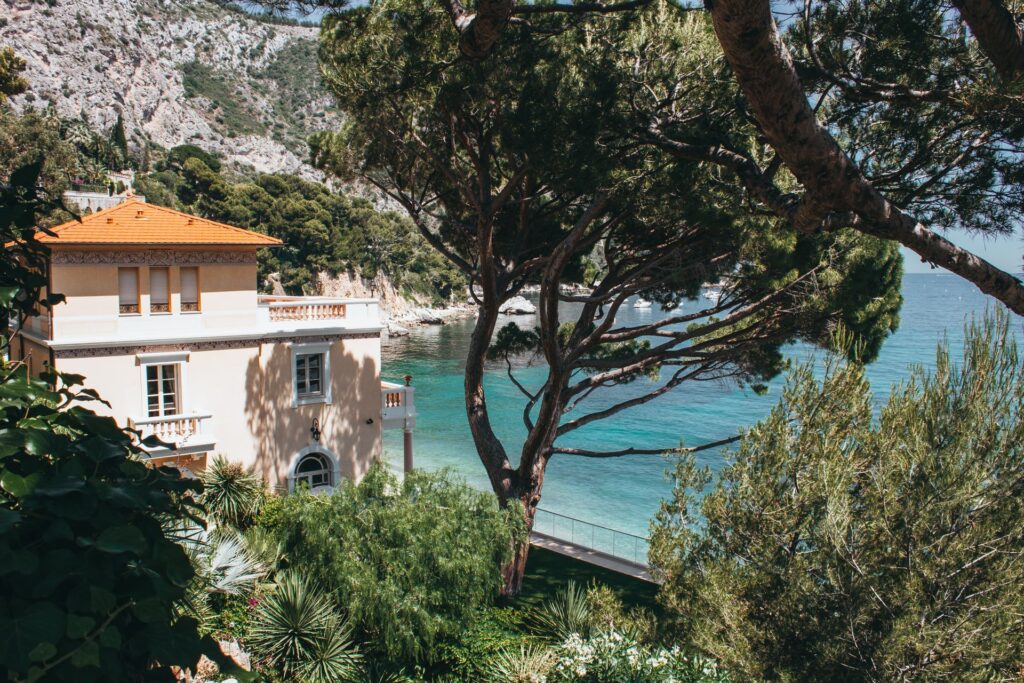

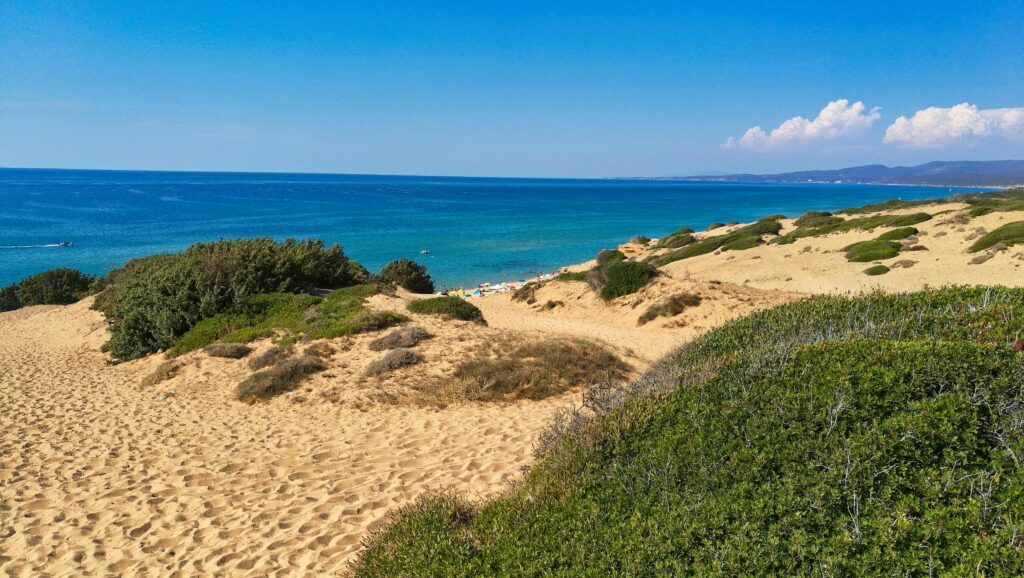
A scenic road descending from Cagliari, crossing the pine forests of Pula, and suddenly, the revelation. Before you, Chia Bay opens onto one of the most iconic postcards of the Mediterranean: white sand dunes descending to a sea in impossible shades, a lagoon where pink flamingos alight, and above, the white lighthouse of Capo Spartivento. Welcome to one of the last preserved paradises of southwest Sardinia.
In summary
Chia is a hamlet in the municipality of Domus de Maria, 50 km southwest of Cagliari, eligible for the 7% tax regime for foreign retirees. Its coastline concentrates some of Sardinia’s most beautiful beaches: Su Giudeu, Cala Cipolla, Tuerredda, in a setting of dunes, lagoons and Mediterranean scrubland. The real estate market here is particularly high-end and discreet, with premium villas frequently exceeding 5 million euros for beachfront properties.
Areas to Search for a Property
Chia is not a village in the classical sense: it is a dozen residential zones scattered through scrubland and pinewood, each with its own character.
Su Giudeu and Su Portu – The Epicenter
The most coveted and rarest area. Beachfront villas or just a few steps from the sand, often in private residential hamlets. Beachfront properties are virtually impossible to find on the public market. Their sale takes place by word of mouth.
Profile: premium villas of 200 to 500 m² on plots of 2,000 to 10,000 m².
Capo Spartivento and Chia Laguna
Around the promontory and the Chia Laguna estate, a 5-star hotel complex that structures part of the high-end residential fabric. Villas with panoramic sea views, refined Mediterranean architecture, resort service access. This is one of the most exclusive areas.
Tuerredda and Capo Malfatano
A few kilometers to the southwest, towards the most remote tip of the coast. Isolated villas on very large plots, sometimes several hectares, for buyers seeking total seclusion. Trade-off: distance from services and restaurants (15-20 minutes from Chia center).
Pula and Santa Margherita di Pula
15 km to the east, Pula offers real village life with shops, restaurants, year-round services. Santa Margherita di Pula is a residential area of villas edging the pinewood, more structured and accessible than Chia. It’s the compromise for those who want the aesthetics of the southwest coast with more life.
Gastronomy and Addresses
Chia’s cuisine is doubly nourished: seafood products (fish, shellfish, red lobster) and products from the Sulcis, the viticultural and agricultural hinterland. The wines of Sulcis, notably Carignano del Sulcis DOC, made from hundred-year-old vines on sand are among the most distinctive in Sardinia.
As for restaurants, Sa Cardiga, an institution of Sardinian fish cuisine based in Cagliari with another establishment nearby, offers flawless classics. The Conrad Chia Laguna restaurant (formerly Hotel Laguna) offers contemporary Mediterranean cuisine signed by a Michelin-starred Italian chef.
For the hotel experience, Chia Laguna Resort, which brings together several 4 and 5-star hotels across a 60-hectare estate, is the benchmark establishment. Hotel Aquadulci, more intimate, is a 4-star boutique hotel located 500 meters from Su Giudeu beach. For an extraordinary night, Faro Capo Spartivento, an active lighthouse converted into an exceptional hotel, is one of Italy’s most singular addresses: only six suites, 360-degree views over the Mediterranean, underground cinema carved into the rock.
Practical Life and Access
Chia is 55 km from Cagliari, approximately 50 minutes by car via the SS195 then SP71. Cagliari-Elmas airport is 1 hour away. The road hugs the coast for the last twenty kilometers and offers one of the island’s most scenic drives.
As for year-round services: in Chia itself, the supply remains limited—a few restaurants, a bakery, a seasonal pharmacy. For shopping and regular services, you need to drive 10-15 minutes to Pula. Pula offers supermarkets, banks, doctors, primary schools, shops. For hospital services and international schools, back to Cagliari.
Seasonality is marked but less violent than in Costa Rei or Villasimius. Proximity to Pula (15 minutes) more than compensates, with year-round shops, banks, doctors, schools. For foreign retirees seeking tranquility, it’s even an asset. Winter in Chia is singularly beautiful, with nature reclaimed and deserted beaches. For a family with children or an active urban lifestyle, Pula or Cagliari are more suitable.
Chia’s Real Estate Market in 2026
| Zone | Price Range per m² | Property Profile |
|---|---|---|
| Su Giudeu | €8,000 — €14,000 | Premium beachfront villas |
| Capo Spartivento / Chia Laguna | €7,000 — €12,000 | Panoramic view villas |
| Su Portu / Back-beach | €5,500 — €9,000 | Villas in the scrubland |
| Tuerredda / Capo Malfatano | €5,000 — €8,500 | Exceptional isolated villas |
| Santa Margherita di Pula | €4,500 — €7,500 | Villas in the pinewood |
Chia positions itself in the ultra-luxury segment of the south. Beachfront properties in Su Giudeu, when they become available, can reach 10 to 15 million euros for exceptional villas. By comparison, it’s the only place in the south where per-square-meter values match those of Costa Smeralda in the north.
Rarity is structural: the municipality of Domus de Maria has locked down urbanization for thirty years, buildable land is virtually nonexistent, and existing villas are held by families who transmit them internally. The public market is extremely limited for many premium properties; the only means of access is through networks.
OGGI Support in Chia
Chia is probably the most demanding market in south Sardinia. Not for its technical complexity, but for its extreme discretion. The best opportunities are never published. They circulate in a restricted circle of agents, tax lawyers and notaries who pass along information before public announcement. Murielle and Gérard are part of this circle.
On the technical side, renovating villas in a protected coastal zone requires specific expertise: respect for regional landscape constraints, coordination with architects authorized to work in protected zones, liaison with local craftsmen capable of working traditional stone and materials. OGGI mobilizes a network of architects and craftsmen who have been working on these files for twenty years.
In Summary
Chia is, without compromise, one of the last great preserved seaside paradises of the western Mediterranean. The market is tight, properties rare, prices high, but the patrimonial result is guaranteed by a land protection policy that prevents any windfall real estate effect.
For buyers seeking an exceptional seaside residence, inserted into a nature that has resisted time, Chia represents the culmination of what south Sardinia can offer. But it is also the most difficult market to access, the one where the value of a real estate agent introduced to the right network takes on full meaning.
Frequently Asked Questions About Chia
Why is Chia more expensive than Costa Rei at equivalent quality?
Three main reasons. Land scarcity there is more acute: the municipality of Domus de Maria has frozen coastal urbanization with particular strictness. The international renown of Su Giudeu and Tuerredda, regularly ranked among the world’s most beautiful beaches, supports sustained foreign demand. And the presence of ultra-luxury establishments (Conrad Chia Laguna, Faro Capo Spartivento) attracts international clientele who value this positioning. At equivalent size, expect 30 to 50% more than in Costa Rei.
Are there still buildable plots available?
Very rarely, and only in areas defined by the municipal urbanization plan. Beachfront buildable plots have been virtually nonexistent for thirty years. When they become available, usually through inheritance, they are quickly absorbed by the market. For the majority of buyers, the realistic option is purchasing an existing villa, possibly with a renovation project or moderate expansion within landscape constraints.
Is Faro Capo Spartivento accessible to property owners in the area?
Faro Capo Spartivento is a boutique hotel with only six suites, accessible by reservation like any other establishment. But it plays a particular role in the zone’s identity: its existence as an exceptional hotel (and not as a decommissioned military lighthouse) helps enhance the entire Capo Spartivento ecosystem. Many property owners in the area organize dinners or guest stays there. It’s somewhat Chia’s « living room. »
Is Chia livable year-round?
Yes, but it requires accepting seasonality. In Chia itself, winter service offerings are minimal. A few restaurants open, very quiet social life. Proximity to Pula (15 minutes) more than compensates, with year-round shops, banks, doctors, schools. For foreign retirees seeking tranquility, it’s even an advantage. Winter in Chia is of singular beauty, with nature reclaimed and deserted beaches. For a family with children or an active urban lifestyle, Pula or Cagliari are more suitable.
What are the renovation constraints in a protected coastal zone?
All of Chia’s coast is subject to the PUC (Municipal Urban Plan) of Domus de Maria and regional landscape constraints (Regional Landscape Plan). Concretely: impossibility of enlarging existing volumes beyond very limited margins, constraints on exterior materials, maximum heights, minimum distances from the sea. Pools must often be recessed and discreet. Every project must be approved by the competent Soprintendenza, which can lengthen administrative timelines (6 to 18 months depending on complexity). An architect experienced in protected zones is essential.
Is there a golf course nearby?
Yes, Is Molas Resort in Pula, 15 minutes from Chia, has one of Sardinia’s most beautiful 27-hole courses, designed by Robert Trent Jones Sr. It’s one of the structural arguments for international clientele combining seaside residence and golf passion. Several Chia property owners have annual memberships there and frequent the club house as an extension of their residence’s social life.